WhatsApp marketing vs SMS marketing depends on your audience and goals. WhatsApp delivers 98% open rates with rich media and two-way conversations, while SMS reaches every phone instantly with plain text. Choose WhatsApp for engagement, SMS for universal reach and urgent alerts.
Understanding the Core Differences Between These Messaging Channels
WhatsApp marketing vs SMS marketing represents more than choosing between two messaging apps—it's selecting fundamentally different communication approaches for your business. WhatsApp operates over internet connections, requiring users to have the app installed, while SMS travels through cellular carrier networks reaching any mobile phone regardless of smartphone capabilities.
WhatsApp marketing leverages the world's most popular messaging platform with over 2 billion active users, enabling rich conversations with images, videos, documents, interactive buttons, and product catalogues. Messages feel personal and conversational, supporting genuine two-way dialogue where customers can reply naturally and businesses can respond in real-time or through AI assistants.
SMS marketing works through traditional cellular infrastructure, delivering plain text messages up to 160 characters to any mobile number without requiring apps or internet. This universal reach makes SMS ideal for time-sensitive alerts, OTPs, and reaching audiences in regions where WhatsApp penetration is lower. However, SMS remains fundamentally one-way with limited reply capabilities beyond simple keywords
Head-to-Head Comparison: Performance, Features, and Costs
Engagement and Response Rates
The numbers reveal stark differences in how customers interact with each channel: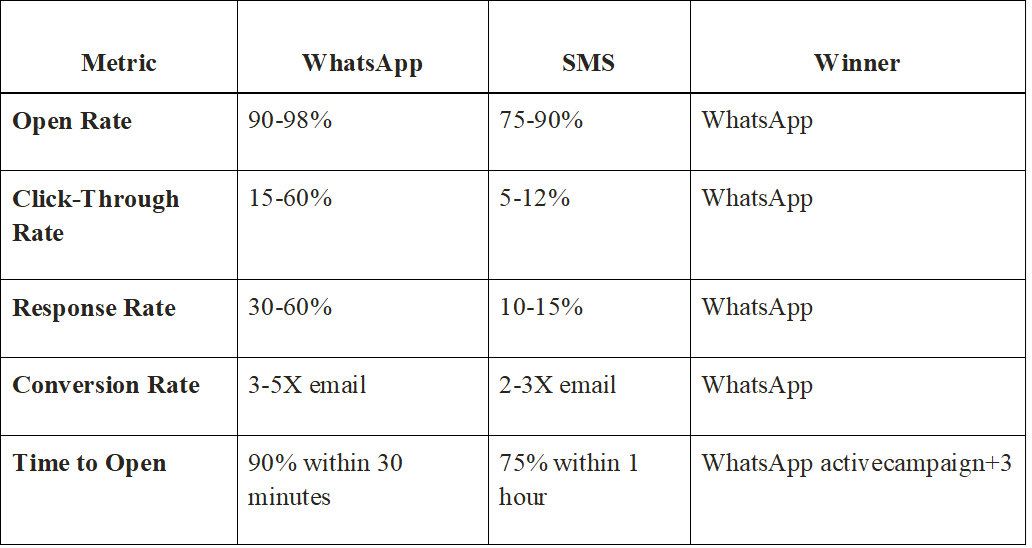 1.png 40.97 KBWhatsApp marketing benefits shine through these engagement metrics. The 98% open rate means nearly every message gets seen, while 45-60% click-through rates dramatically outpace SMS's 5-8%. This translates to 2-4X better ROI for most businesses in WhatsApp-active markets like India, Brazil, and Europe.activecampaign+2
SMS marketing benefits include reliable delivery even without internet connectivity and faster initial visibility for urgent messages. SMS reaches 100% of mobile phones universally, making it indispensable for critical alerts, delivery notifications, and reaching demographics less likely to use smartphones.
Content Capabilities and Richness
WhatsApp messaging supports:
● Text up to 1,024 characters in templates (unlimited in session messages)
● High-quality images, videos up to 16MB
● PDFs and documents up to 100MB
● Voice notes and audio messages
● Interactive buttons (quick replies, call-to-action)
● Product catalogs with images and prices
● Location sharing and contact cards
● Stickers and emojis for personality
SMS marketing delivers:
● Plain text limited to 160 characters per segment (longer messages split and cost more)
● MMS for images at significantly higher cost (3-10X SMS pricing)
● No video, documents, or interactive elements
● Basic emoji support (varies by carrier and device)
● Limited to one-way broadcasts with keyword reply
This content richness makes WhatsApp marketing for businesses ideal for product showcases, detailed explanations, and creating engaging conversational experiences. E-commerce brands can send product images with prices and "Buy Now" buttons directly in messages, while service businesses can share brochures, contracts, or instructional videos.
Cost Structure and Pricing
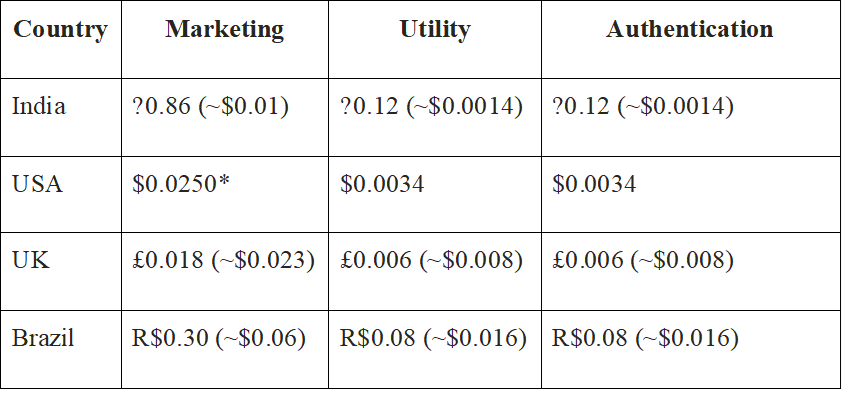
Pricing varies significantly by country and message type:
WhatsApp Business API Pricing (per conversation, 24-hour window):
 2.png 30.58 KBSMS Pricing (per message):
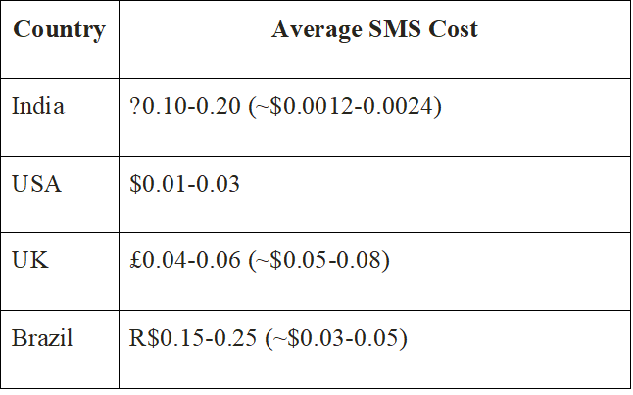 3.png 16.8 KBWhatsApp marketing campaigns often deliver lower cost per conversion despite higher per-message costs because of superior engagement. If WhatsApp costs 5X more per message but converts 10X better, your actual cost per sale drops by half. For transactional messages (order confirmations, shipping updates), WhatsApp is dramatically cheaper in most markets.
SMS marketing for businesses remains cost-effective for high-volume, simple notifications where rich content isn't necessary. Sending 10,000 delivery alerts via SMS might cost $100-300, while the same via WhatsApp could cost $100-200 in utility rates—but SMS requires no template approval and reaches 100% of customers.
Reach and Accessibility
SMS wins decisively on universal reach:
● Works on every mobile phone ever made (2G, 3G, 4G, 5G)
● Requires no app installation or internet connection
● Reaches customers in areas with poor data coverage
● No geographic restrictions or platform dependencies
● Ideal for older demographics less comfortable with apps
WhatsApp has massive but selective reach:
● 2+ billion users globally (about 25% of world population)
● Requires smartphone with app installed and internet connection
● Dominant in India (500M+ users), Brazil (150M+), Europe (300M+), Latin America
● Lower penetration in USA (about 30% of population), Japan, South Korea
● Growing rapidly among younger demographics globally.
For WhatsApp customer engagement, focus on markets where penetration exceeds 50%: India, Brazil, Mexico, Argentina, Spain, Italy, Germany, Indonesia, and most of Africa. In these regions, WhatsApp often outperforms SMS on both reach and engagement.
Compliance and Regulatory Requirements
SMS Marketing Compliance:
● USA: TCPA (Telephone Consumer Protection Act) requires explicit opt-in, 10DLC registration for business messaging, STOP/START keyword support
● UK/EU: GDPR compliance, PECR regulations requiring consent
● India: TRAI DLT (Distributed Ledger Technology) registration mandatory for all business SMS, template approval required
● Global: Opt-out mechanisms required, quiet hours restrictions in many countries
WhatsApp Marketing Compliance:
● Meta Business Platform policies require explicit opt-in for marketing messages
● Template messages must be pre-approved by Meta (24-72 hour review)
● 24-hour session window: free customer service replies within 24 hours of customer message
● Quality rating system: low-quality messages can get your number banned
● User-initiated conversations (customer messages first) have fewer restrictions
WhatsApp marketing for businesses requires more upfront compliance work but offers clearer guidelines. Template approval ensures messages meet quality standards, reducing spam complaints. SMS compliance varies more by country and carrier, requiring ongoing monitoring of regulatory changes.
When to Choose Each Channel for Maximum Impact
Ideal Use Cases for WhatsApp Marketing
WhatsApp marketing campaigns excel in these scenarios:
1. Product Showcases and E-commerce Sales
○ Send product images with prices and "Shop Now" buttons
○ Share video demonstrations and customer testimonials
○ Create interactive catalogs customers can browse
○ Recover abandoned carts with personalized product reminders
2. Customer Support and Conversations
○ Provide real-time support through chat
○ Share troubleshooting videos and PDF guides
○ Enable customers to send photos of issues
○ Build ongoing relationships through personalized dialogue
3. High-Value Customer Nurturing
○ Send personalized recommendations based on purchase history
○ Share exclusive offers with rich media
○ Conduct surveys with interactive buttons
○ Build VIP customer communities
4. Appointment Reminders and Confirmations
○ Send calendar invites with location maps
○ Allow customers to reschedule with button clicks
○ Share preparation instructions with images
○ Reduce no-shows with engaging reminders
○ Create visually appealing invitations
○ Enable one-click RSVP with buttons
○ Share event details with maps and schedules
○ Send follow-up content and recordings
Ideal Use Cases for SMS Marketing
SMS marketing for businesses dominates in these situations:
1. Time-Sensitive Alerts
○ Flash sale announcements (limited-time offers)
○ Emergency notifications (service outages, weather alerts)
○ Security alerts (suspicious login attempts)
○ Last-minute appointment changes message
2. Delivery and Transaction Notifications
○ Order confirmation and shipping updates
○ OTP (One-Time Password) for authentication
○ Payment confirmations and receipts
○ Service technician ETA notifications
3. Reaching Non-Smartphone Users
○ Older demographics (65+)
○ Developing regions with low smartphone penetration
○ Customers with basic feature phones
○ Backup channel when WhatsApp fails
4. Simple Reminders and Alerts
○ Appointment reminders (text only)
○ Bill payment due dates
○ Subscription renewal notices
○ Low balance or usage threshold warnings
5. High-Volume, Low-Cost Broadcasts
○ Mass announcements to entire customer base
○ Simple promotional codes
○ Basic survey requests
○ Opt-in confirmation messages
Strategic Recommendation: Use Both Channels Together
The smartest approach isn't choosing WhatsApp vs SMS marketing—it's using both strategically with automatic fallback:
Primary Channel Strategy
● Use WhatsApp as primary for customers in high-penetration markets (India, Brazil, Europe, Latin America)
● Use SMS as primary for USA-focused audiences, older demographics, and critical alerts
● Segment by customer preference when possible (let customers choose their channel)
Automatic Fallback System
Implement intelligent routing:
1. Attempt WhatsApp delivery first (lower cost, higher engagement)
2. If WhatsApp fails (no app, undelivered), automatically send SMS
3. Track which channel each customer responds to best
4. Optimize future sends based on individual response patterns
This approach ensures 100% reach while maximizing engagement. You get WhatsApp's rich features and superior ROI where possible, with SMS as reliable backup guaranteeing message delivery.
Real-World Performance: What Businesses Actually Achieve
WhatsApp Marketing Results
Companies report:
● 98% open rates within 30 minutes of delivery
● 45-60% click-through rates on promotional messages
● 3-5X higher conversion rates compared to email
● 85% higher response rates versus SMS
● 2-4X better ROI in WhatsApp-dominant markets
● 60-98% open rates consistently across industries
E-commerce example: An Indian fashion brand sending WhatsApp product catalogs with "Buy Now" buttons achieved 52% click-through and 18% conversion rates—5X better than their SMS campaigns. Cost per acquisition dropped 60% despite higher per-message costs.
SMS Marketing Results
Companies report:
● 90-98% open rates (though often lower actual engagement than WhatsApp)
● 5-12% click-through rates on average message
● 2-3X higher conversion rates compared to email
● 99.9% deliverability rate universally
● Instant delivery within seconds
● Reliable performance for OTPs and critical alerts
Retail example: A US-based retailer sending SMS flash sale codes achieved 11% redemption rates with 95% delivery within 3 seconds. While lower than WhatsApp's potential, SMS reached 100% of their customer base including non-smartphone users.
Implementation Best Practices for Both Channels
WhatsApp Marketing Best Practices
1. Obtain Explicit Opt-In
○ Use clear checkboxes: "Receive WhatsApp offers"
○ Explain message frequency and content type
○ Provide easy opt-out instructions in every message
○ Never add customers without permission active
2. Craft High-Quality Templates
○ Keep messages concise and valuable
○ Use personalization (customer name, past purchases)
○ Include clear call-to-action buttons
○ Test templates before submission to Metaactive
3. Leverage Rich Media Strategically
○ Use images/videos to showcase products
○ Keep file sizes optimized for fast loading
○ Ensure media adds value, not just decoration
○ Test on different devices before sending message
4. Enable Two-Way Conversations
○ Respond promptly to customer replies
○ Use AI chatbots for instant responses
○ Escalate complex issues to human agents
○ Track conversation quality ratings
5. Monitor Quality Metrics
○ Watch for blocks and spam reports
○ Maintain quality rating above "Medium"
○ Adjust frequency based on engagement
○ Sunset underperforming template
SMS Marketing Best Practices
1. Comply with Regulations
○ Register for 10DLC (USA) or DLT (India)
○ Obtain explicit written consent
○ Include STOP instructions in every message
○ Honour opt-outs immediately message
2. Keep Messages Concise
○ Stay under 160 characters when possible
○ Put key information first
○ Use clear, actionable language
○ Avoid abbreviations that confuse readers
3. Time Messages Appropriately
○ Send during business hours (9 AM - 8 PM local time)
○ Avoid weekends unless urgent
○ Consider time zones for national campaigns
○ Test different send times for optimization
4. Use for Time-Sensitive Content
○ Flash sales and limited offers
○ Appointment reminders
○ Delivery notifications
○ Security alerts
5. Track and Optimize
○ Monitor delivery and click rates
○ A/B test message copy
○ Segment audiences by response behaviour
○ Remove non-responders to reduce costs