Lead management vs lead generation comes down to timing: generation brings new contacts in, management makes sure none of them get lost afterward. Both matter, but they're different jobs with different goals, tools, and people responsible for them.
What Is Lead Generation?
It's the work of getting a stranger interested enough in your business to hand over their contact information. That could be a blog post that ranks on Google, an ad that stops someone mid-scroll, a webinar sign-up, or a referral from an existing customer. Whatever the channel, the goal is the same: turn an anonymous visitor into a named contact a sales or marketing team can actually reach.
It's a numbers game by nature. Not every visitor converts, not every download turns into a real prospect, and that's expected. The job here isn't to close a sale; it's to build a steady, reliable supply of people worth talking to in the first place. Without this step, there's nothing for the rest of the sales process to work with.
A quick example makes this concrete. A software company publishes a genuinely useful comparison guide, someone searching for that exact topic finds it, and they trade their email address for a free checklist mentioned inside. Nobody has picked up a phone or pitched anything yet. That single trade, an email for something useful, is the entire transaction this stage is built around.
What Is Lead Management?
It's everything that happens to a contact after they've raised their hand. It covers organizing new leads, scoring how likely each one is to buy, assigning them to the right person, and making sure follow-up actually happens instead of quietly slipping through the cracks.
Where the previous stage is about volume, this one is about care. A hundred new contacts a month means nothing if forty of them never hear back, or if the ten most promising ones get treated the same as the ten least promising. This stage is the difference between a pile of names and an organized pipeline someone can actually work.
Picture that same software company a day later. The person who downloaded the checklist gets a short, personal reply instead of a generic blast, a note lands in a rep's queue flagging them as worth a call, and a reminder fires automatically if nobody follows up within forty-eight hours. None of that happens by accident; it's the direct result of a system built to catch exactly this kind of moment.
The Difference Between Lead Management and Lead Generation
The simplest way to separate the two: one brings people in, the other keeps track of them once they're inside. Think of a store. Advertising that pulls a shopper through the door is one job. A salesperson who greets them, remembers what they were looking at, and follows up later is a completely different job, even though both matter equally to whether that shopper eventually buys something.
Timing separates them too. The first stage happens before anyone in sales has a real conversation with a person; the second stage starts the moment that person becomes a named contact and continues for as long as the relationship does, sometimes well past the first purchase. Confusing the two, or assuming success at one guarantees success at the other, is a common reason marketing and sales teams end up blaming each other for missed targets.
Ownership tends to split along similar lines, though not always cleanly. Marketing usually owns the earlier stage since it involves content, ads, and campaigns; sales usually owns the later one since it involves conversations and closing. The friction shows up in the middle, right at the handoff, where a lead can sit unclaimed if neither side is entirely sure whose job it is yet to pick it up.
A simple test cuts through most of the confusion: ask whether an activity is trying to reach someone new or trying to move someone already known further along. Writing a blog post falls on one side; calling a contact back after they asked a pricing question falls squarely on the other. Most disagreements about who owns what disappear once a team applies that one question consistently.
Lead Management vs Lead Generation at a Glance
Seeing the two side by side usually makes the split click faster than any explanation does.
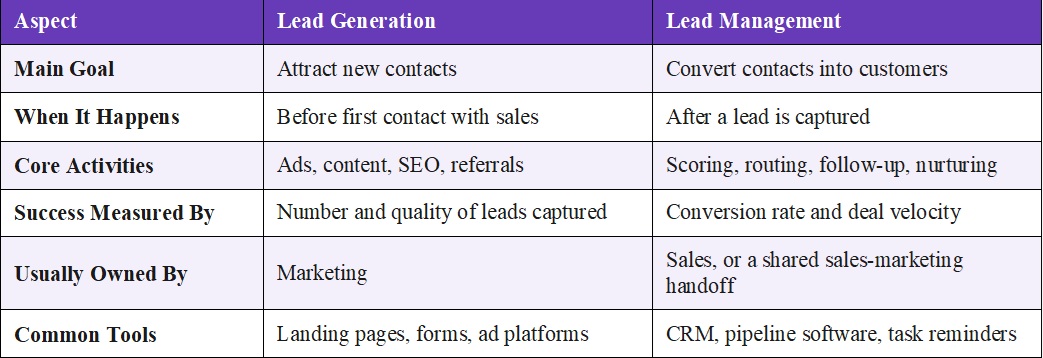 leadnest.ai image.jpg 120.82 KBLooking at it this way, the two stop feeling like competing ideas and start looking like connected halves of the same job. Neither one produces much without the other doing its part.
It usually starts with attention: content, ads, or word of mouth that puts your business in front of someone who has a relevant problem. From there, that attention needs somewhere to go, typically a landing page or form built around a single, clear offer instead of ten competing options.
Once someone fills out that form, they've technically become a lead, but the process isn't finished. A confirmation message, a first response, and a clear next step all still need to happen quickly, because interest fades fast. A contact who hears nothing back within the first day or two often assumes nobody's paying attention and moves on to whichever competitor replies first.
Tracking where people drop off along the way matters just as much as the final count. If a page gets plenty of visitors but almost nobody fills out the form, the offer or the page itself is usually the problem, not a lack of traffic. Fixing that one weak link often does more for the total number of contacts than doubling the advertising budget ever would.
What the Lead Management Process Actually Involves
It kicks in the moment a new contact lands somewhere a team can see it. Step one is usually scoring: deciding how serious this particular lead looks based on what they did, downloaded, or said. Step two is routing, getting that contact to whichever rep or team is actually equipped to help them.
From there it's a cycle of follow-up, notes, and timing. A good system reminds someone to reach back out before a lead goes cold, tracks what's already been said so nobody repeats themselves, and flags when a contact has gone quiet long enough to need a different approach. Skip any one of those steps consistently and leads simply evaporate, not because anyone did anything dramatically wrong, but because nobody was watching closely enough.
The steps rarely happen in a strict straight line either. A contact might get scored as low priority, go quiet for a month, then suddenly re-engage after opening three emails in a single week. A rigid system that only looks at a lead once tends to miss that shift entirely, while one built to notice behavior changes catches it and adjusts priority automatically.
Where Lead Nurturing Fits In
Not every new contact is ready to buy the moment they show up, and that's where this next stage earns its keep. It's the ongoing work of staying useful and visible to a lead who isn't ready yet, through things like helpful emails, relevant content, or the occasional check-in call, without pushing so hard that they disengage entirely.
Done well, this closes the gap between someone showing mild curiosity and someone genuinely ready to have a sales conversation. Done poorly, or skipped altogether, a business ends up with two extremes: leads chased so aggressively they unsubscribe, or leads left alone so long they forget your business ever existed. The right cadence sits somewhere in between, guided by what the contact actually does rather than a fixed schedule.
Timing beats volume here almost every time. Three well-timed, relevant messages spread across a month tend to outperform ten generic ones crammed into a week, because the goal isn't to stay top of mind through sheer repetition, it's to show up right when the contact is actually thinking about the problem again.
Lead Conversion: The Finish Line for Both Stages
Everything before this point exists to support that moment when a contact actually becomes a paying customer. It's the metric that ultimately proves whether generation and management were both working, since a business can generate plenty of interest and still convert almost none of it if the follow-up side falls apart.
Tracking this properly means looking past the final “yes” to see where deals stall out along the way. If a large share of leads drop off at the same specific step, that step, not the lead source, is usually the real problem worth fixing first. Chasing more traffic rarely helps if the leak is happening after people already arrived.
A pricing page that gets plenty of visits but few follow-up replies, for instance, points to a very different fix than a form that barely gets any submissions in the first place. Diagnosing which stage is actually broken saves a business from spending money on more traffic when the real issue was a slow reply or a confusing next step.
This side of the process is easy to underinvest in because it's less visible than a flashy ad campaign or a viral post. Nobody celebrates a well-organized pipeline the way they celebrate a traffic spike, even though the pipeline is usually what actually pays the bills.
A rep juggling deals without a real system tends to default to whoever's loudest or most recent, not necessarily whoever's most likely to buy. Structure fixes that: clear ownership of each contact, a standard for how fast a new lead gets a first reply, and a simple way to see which deals have gone quiet. None of it requires anything exotic, just consistency applied to every single contact instead of only the ones that happen to be top of mind that day.
A manager benefits from this structure just as much as the reps do. Instead of asking each person individually how their contacts are going, a shared view shows exactly where every deal sits, which reps are consistently fast to respond, and which ones need coaching on follow-through rather than more leads to work with.
Lead Generation Strategies Worth Knowing
A handful of approaches tend to outperform the rest regardless of industry. Content built around real questions people are already searching for brings in visitors who arrive with genuine intent, rather than people who clicked an ad out of curiosity and bounced seconds later. Referral programs work similarly well, since a lead who arrives recommended by someone they trust tends to convert at a noticeably higher rate than a cold one.
Paid channels still have a place, particularly for speed, since organic growth takes months to compound while an ad can start sending traffic the same day it launches. The mistake worth avoiding is leaning on just one channel indefinitely; a source that performs well today can quietly stop working as algorithms, costs, or audience habits shift, and a business with only one working channel has no backup when that happens.
Partnerships and co-marketing deserve more attention than they usually get too. Teaming up with a business that already has the same audience, without being a direct competitor, gets a brand in front of genuinely relevant people at a fraction of the cost of cold advertising, and it tends to come with a built-in layer of trust an ad alone can't buy.
Common Mistakes That Blur the Line Between the Two
The most frequent mistake is treating a full pipeline as success on its own. A hundred new contacts a month looks great on a dashboard, but if half of them never get a real follow-up, that number is closer to vanity than value.
A second mistake is the reverse: obsessing over process and follow-up discipline while the top of the funnel quietly dries up. A perfectly organized system managing forty leads a month will always lose to a messier one managing four hundred, at least until both sides get fixed together.
A third, quieter mistake is leaving no clear handoff between the two stages. When nobody owns the moment a lead moves from “just captured” to “actively worked,” contacts sit untouched in the gap, and both sides end up assuming someone else already reached out.
A fourth mistake is judging both stages by the same metric. Total contacts captured and total deals closed measure completely different things, and holding one team accountable to the other's number usually just breeds resentment instead of better results. Each stage needs its own yardstick, even while everyone stays focused on the same final outcome.